

As Blaise Pascal famously said, “Truth is so obscure in these times, and falsehood so established, that, unless we love the truth, we cannot know it.”
The crazy thing is, he said that long before computers, the internet, social media, and AI. If truth was obscure in his times, it’s like a needle in a haystack in ours. It takes an incredible amount of work to sort through all the static and find what’s really true, and we won’t put in that work unless we really love the truth.
When it comes to the Bible, the stakes are that much higher, and love for the truth is that much important.
There is no end to the list of debated Bible issues. These issues range from foundational matters like the role of baptism, down to the meat and potatoes of everyday life like gender roles or Christian political action, all the way to the trivial, like the matter of the Nephilim.
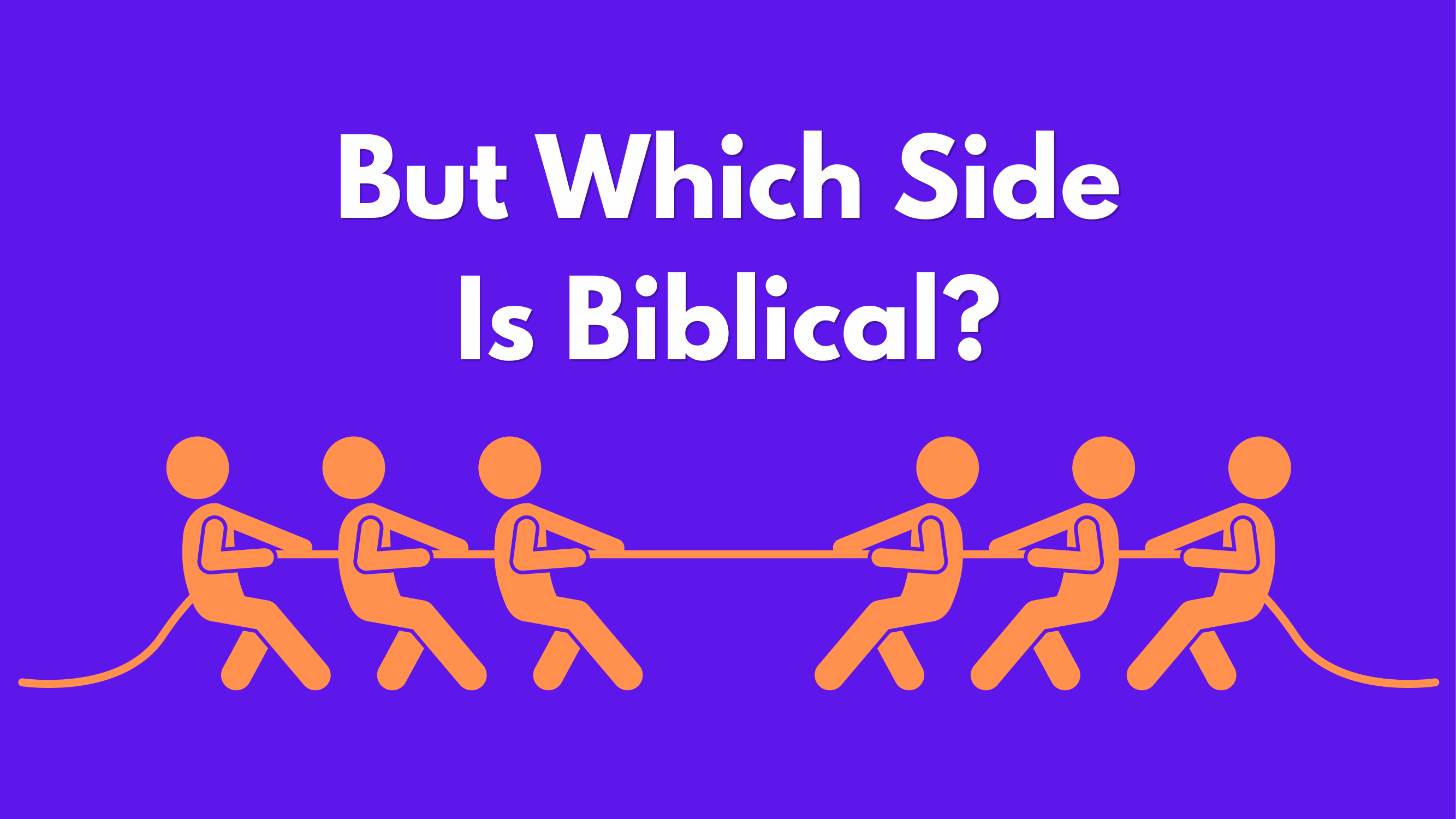
We all want to side with the Bible in our beliefs… but how do we know what side the Bible is on?
On each of these and countless others, multiple parties all claim their view is the Biblical one. They can even support their interpretation with Scripture. Just saying “I believe what the Bible says” isn’t enough.
Once again, finding the truth takes a lot of work. Choosing a viewpoint and seeing how it holds up to cross-examination is a process that must involve a good deal of prayer and study, and a determination to not take short cuts. And as you study, you have to use discernment and ask good questions to see which side best aligns with the fullness of God’s Word.
Here are a few questions to ask when you're seeking to figure out which view best represents the Scriptures.
1. Which view best synthesizes the Scriptures?
When you’re trying to figure out which view reflects the Biblical text, you don’t want to come out with spare puzzle pieces you couldn’t make fit. Serious Bible students don’t play Scripture Wars, because the Bible doesn’t contradict itself.
In my baptism debate with Jeremiah Nortier, he played Scripture Wars, and seemed to think I was doing the same. He pitted the faith verses against the baptism verses, essentially saying that because we are saved by faith, Acts 22:16 can’t mean what it says.
Instead of firing Acts 22:16 back at a verse like Ephesians 2:8, we must explain how the two verses can mean exactly what they say and still not contradict each other. If faith excludes baptism, then Acts 22:16 must be discarded or reworded. If faith includes baptism, we don’t have a problem. That view synthesizes the texts.
The problem is, properly synthesizing the texts takes longer, and some people won’t stick around for the process. Unless you love the truth, you’re going to be a sucker for Scripture Wars.
The same is true of ongoing controversies like male and female roles in God’s design, as I’ve written so much on in recent months. “…just as Sarah obeyed Abraham” and “Husbands, love your wives as Christ loves the church” are not an either-or choice. We must develop a view that incorporates both verses. Drive-by analysis is always going to miss the synthesizing process.
2. Which one is novel?
This doesn’t always work, as sometimes both sides have historical claims and the evidence can be murky. But many times it does.
If nobody held a particular view for centuries upon centuries, and then somebody decided that everybody before them was wrong, that should raise some eyebrows.
Such is the case with the gender roles discussion. The kinds of takes you see from egalitarians in the church and feminists and even complementarians in the home are largely inventions of the last 100 years. The same can be said of baptism for salvation at the time of the Reformation, as even Zwingli admitted that every single Christian after the apostles and up to his day had disagreed with him about the doctrine:
“In this matter of baptism, all the doctors have been in error from the time of the apostles…. For all the doctors have ascribed to the water a power which it does not have and the holy apostles did not teach.”
When you’re in that position, saying “every Christian in history was wrong until I got here,” it’s worth taking a step back and reevaluating.
Even in this, we must remain vigilant. Everybody knows that history pulls weight, and so rarely does anybody present their view as something new. Take “servant leader,” for example. The concept as it is currently taught is completely ahistorical and, as I’ve argued, incompatible with Scripture. But the term itself sure sounds grounded in history, doesn’t it? Thus, we must not just look for what sounds historical, but what is.

Tradition doesn’t answer everything, as man has gotten plenty of things wrong throughout history, and tradition isn’t always in agreement. But if, as Chesterton said, tradition is the “democracy of the dead,” getting outvoted 19 centuries to 1 should give one pause.
3. What are the fruits?
Drive-by analysis doesn’t ever stop to ask about second order effects, like “What will result if we adopt this belief?” Nor does it take a look around to see what has resulted from such ideas.
The Bible has plenty to say about fruits, though. Indeed, we would be terribly unwise if we didn’t check an idea’s fruits.
To draw on our ongoing examples once again, abandoning baptism for salvation led to a lot of easy-believism and ultimately resulted in sinner’s prayer “conversions” via television. Not great fruits, huh?
Feminism and complementarianism have strongly correlated with higher divorce rates, greater cohabitation rates, plummeting birth rates, and skyrocketing mental health struggles. We also have the church’s elephant in the room, that many congregations are quietly run by a group of women who hold sway over the leadership. Once again, the fruits are rotten.

When we lack the attention span needed to look around and see how an idea has played out, or calculate how it most likely would, it makes it that much harder to choose which view aligns with the Bible.
There is no cheat sheet
Every debated view has to be evaluated to some degree, and we can’t just default to the option that sounds nicer. Nor can we farm out our decision making to what mom, dad, or brother so-and-so says. Nor can we choose the path of least resistance.
As Hebrews 5:14 teaches us, the mature are those who have put in the practice to train their senses to discern good and evil. That is a process that requires us to go to the Book over and over, and then look through its lenses to see the world around us.
The more we do that, the sharper our senses become, and the easier it gets to hold a coherent worldview. And, the better we get at seeing through arguments that sound Biblical but aren’t grounded in truth.
Truth can indeed be obscure in these times, but that doesn’t mean it’s impossible to find. Have the humility to pray for guidance and ask the right questions and you’ll end up where you need to be.
Subscribe for free, or become a supporting reader and get digital downloads of all of my books!
Notes
If you missed it, check out my post about next year’s event!
Think Deeper Podcast this week looks at how we can prepare for the church’s future


