

Longtime readers here or listeners of Think Deeper Podcast know I hate the term “Servant Leadership.”
However, in posting about it on a couple of my social accounts, the feedback I got made me realize I haven’t ever fully spelled out why. To avoid any confusion for what I do and don’t believe on the matter, I wanted to write this to have as a reference any time the discussion arises.
The best piece on the issue was written by Aaron M. Renn here:

Read that one especially for the plethora of examples taken from major evangelical voices that establishes the concept of “Servant Leadership” that I’m writing against today.
Still, I’d like to explain my own issues with the term, but especially with the kind of verbal tactic the term represents.
Two Reasons Why I Hate “Servant Leadership”
It isn’t leadership
To be clear, I do not hate service, leadership, or leadership that serves. I hate the term Servant Leadership, and am capitalizing it in this article to distinguish it as the title of an idea rather than a concept made up of its parts.
By Jesus’ own words, service is nothing less than a requirement for leaders. Anyone who wants to be great must serve (Mark 10:42-44). Even as King of Kings, He insisted He came to serve rather than be served (Mark 10:45), and He backed that claim up all the way to a brutal death on the cross.
But here’s the key: what does serve mean?
Service means loving your followers enough to do what is in their best interests according to God’s standards. A leader who won’t do that is neither a servant nor a leader, ironically enough.
For this reason, Jesus did not spend His ministry washing feet. He did it one time, and that was to teach His apostles that they cannot be above service. Likewise, the apostles did not then set up a foot washing booth. In fact, they appointed other men to distribute bread to the widows, because they themselves needed to continue their ministry of the Word (Acts 6:2).
Mission mindedness and delegation is how Jesus served, how the apostles served, how Moses and David served, and so forth. If our understanding of service doesn’t include those then it isn’t Biblical.
Servant Leadership, on the other hand, turns subservience itself into leadership.
When a controversy arises and there’s a 50-50 decision to be made, the leader is told to be a Servant Leader, which means he’s supposed to cave in. Sometimes that’s the right call, sometimes it isn’t. Servant Leadership does not make the distinction.
It is the “Gentle Parenting” of marriage, eldership, and governance in that the term sounds nice, but when you peel back the layers you start to realize it means the Servant Leader doesn’t lead at all, just as the Gentle Parent doesn’t parent at all. Rather, the leader is there to manage feelings and facilitate the follower getting what he or she wants.
Thus, Servant Leadership in the church means capitulating to the demands of the squeaky wheels. Servant Leadership in the home means never making a decision that your wife doesn’t agree with. Servant Leadership in governance means never doing anything that will bring bad PR.
In short, it usually means being a doormat. (If you don’t believe me, check out the Renn article linked above for numerous examples from men like John Piper, Tim Keller, and Russell Moore.) I hate Servant Leadership because it is not leadership it all, and it damages the people under it.
True leadership should mean making the right decision regardless of the pushback it brings. Taking on the pushback and emotional manipulation that comes from making the unpopular decision is one of the ways a leader serves.
Giving the kids ice cream for dinner every night to avoid a temper tantrum isn’t service. Making them eat their vegetables knowing full well it may bring a temper tantrum and then correcting them until they stop throwing temper tantrums is how a leader serves.
That kind of service is way, way harder—and way, way more sacrificial. Most people can see that when kids are the example. When it’s congregations, constituents, and wives, suddenly we lose sight of it. But no matter how much people insist on not seeing it, we need loving, sacrificial leaders to do it anyway.
Sometimes an eldership serves their people by firing the preacher. Other times an eldership serves their people by insisting they won’t fire the preacher. Sometimes a husband will need to serve his wife by doing the dishes. Other times he will need to serve his wife by not doing the dishes, and by reminding her she needs to get them done. Servant Leadership pushes the former and all but forbids the latter in each of these cases.
So, when you see a man being criticized for his lack of Servant Leadership, take a second look. Is he being bull-headed… or is he simply refusing to bow to someone’s whims or passive aggression?
It’s a dirty linguistic tactic
I should not have to say I oppose Servant Leadership. It would be a perfectly good term if it didn’t carry all this baggage. But that’s exactly why it was adopted.
The minute you say you oppose it you are cast in the role of disagreeing with Jesus, and you clearly just want to steamroll everyone and get your way. The way they play the game, to say “I’m against Servant Leadership” is to say “I should get to do whatever I want.” The well has been poisoned before the discussion even began.
The truth is, we are a culture that hates leadership. We’re so scared of the idea that our modern translations have abandoned “rule” for “manage” (see 1 Timothy 3:4-5 in NASB and ESV vs. KJV and ASV). “Submit” is a bad word. We’re willing to follow leaders only if they do what we would do if we were in charge, which means we’re not actually following them at all—we’re just letting them walk in front of us until we part ways.
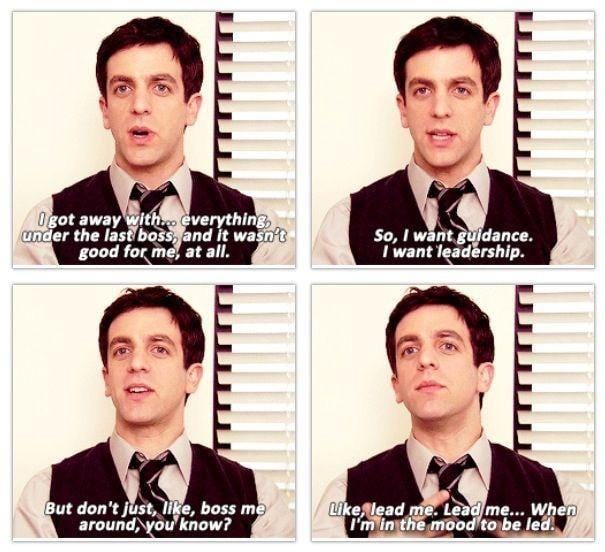
Since that’s clearly sinful and unbiblical, we came up with a term that sounds incredibly Biblical, used it to get the kind of fake figurehead leadership we wanted, assuaged our own consciences, and shut down anybody who calls out our trick play.
That’s why we have to have inquisitiveness and a good attention span, or we are suckers who are ripe for deception.
As demonstrated above, modern Servant Leadership is the selfish avoidance of difficult decisions. There’s nothing Christlike about that at all. But people who drive by the conversation, see two words that they like, and form a conclusion will never understand that.
I’ve explained it before, but this is a classic Motte-and-Bailey fallacy. In short, a Motte and Bailey operates as follows:
Hide a controversial, difficult to defend idea (the Bailey) behind an uncontroversial, easy to defend idea (the Motte)
Wait for someone to attack the controversial idea
Pretend they’re attacking the uncontroversial one


Servant Leaders: “Happy wife, happy life.”
Me: But doesn’t that make her temporal happiness the marriage’s highest principle?
Servant Leaders: “So you don’t think husbands should serve their wives (Ephesians 5:25)???”
When you see it, it’s as transparent and phony as it gets. But do you love the truth enough to take a long enough look to see it? In our age of TikToks and tweets, most don’t. I trust my readers have more interest in the truth than that, though. That doesn’t mean we’re always going to come out on the same side of an issue, but we can avoid the sanctimonious point-scoring tactics of the people who make these conversations so complicated.
So, whether it’s about Servant Leadership or any other seemingly obvious concept, it’s worth playing the role of spelling bee kid and asking them to use it in a sentence and give a definition.
We need leaders who serve, not Servant Leaders
A Christian who will not serve cannot lead like Christ. At the same time, if “serving” in practicality means not leading at all, then we should reject it. Clear, Biblical, Christ-like leadership is a pretty simple concept, no matter how difficult it might be for us to live by when we don’t like it.
But we don’t get to invent our own faux-Biblical terms to skirt around our duty. That, more than anything, is what I hope is your takeaway: what sounds good and what is good are often diametrically opposed, because the father of lies who hates God’s authority works awful hard to get us to be subversives like him. Don’t take that bait.
I hope you all have a Merry Christmas!
If you waited too long to get a gift shipped, don’t forget you can get plenty of my work digitally on Kindle or pdf (at focuspress.org/shop).
And, you can gift subscriptions that come with 5 complimentary eBooks, including the brand new You Are Saved: The Christian’s Assurance!
One of the points that Aaron Renn has made in recent years is that the Servant Leader Husband apparently has no goals of his own. His wife and children have outcomes they desire in life, and he must try to satisfy them through his Servant Leadership. But, apparently, the husband/father has no particular ambitions to accomplish in this life that anyone needs to help him achieve.
So, he must do all the spiritual growing, while his wife and children are permitted to stagnate spiritually by taking on the role of voicing what they want.
The analogy to being an elder is to note that the conception of congregational elder as someone who juggles all the desires of the congregation and tries to maximize the satisfaction of sometimes contradictory desires relegates the members to the status of spiritual infants. The alternative is to challenge each member to think about the good of everyone else and not just their own desires. In other words, grow up emotionally and spiritually. Before you tell the elders that you don't like the way a certain thing is being done, ask yourself whether other members think the exact opposite. Don't leave it up to the elders to deal with these opposite desires; challenge yourself to exercise forbearance towards fellow members.
In both cases, shall the Servant Leader take on herculean tasks while everyone else simply voices their preferences and desires?