


Today I want to present to you a dissection of one of the greatest examples I’ve ever seen of how religious compromise happens.
In the early pages of Herman Melville’s classic novel, Moby Dick, the main character and narrator, Ishmael, finds himself in an interesting quandary. Queequeg, his new pagan friend, pulls out an idol to worship.
After previously having his “Maybe we’re not so different after all” moment, Ishmael is now put in the position of having to choose how to respond to one thing that makes them markedly different: namely, Queequeg’s idolatry.
By certain signs and symptoms, I thought he seemed anxious for me to join him; but well knowing what was to follow, I deliberated a moment whether, in case he invited me, I would comply or otherwise.
I was a good Christian; born and bred in the bosom of the infallible Presbyterian Church. How then could I unite with this wild idolator in worshipping his piece of wood? But what is worship? thought I. Do you suppose now, Ishmael, that the magnanimous God of heaven and earth—pagans and all included—can possibly be jealous of an insignificant bit of black wood? Impossible!
But what is worship?—to do the will of God—that is worship. And what is the will of God?—to do to my fellow man what I would have my fellow man to do to me—that is the will of God. Now, Queequeg is my fellow man. And what do I wish that this Queequeg would do to me? Why, unite with me in my particular Presbyterian form of worship. Consequently, I must then unite with him in his; ergo, I must turn idolator.
So I kindled the shavings; helped prop up the innocent little idol; offered him burnt biscuit with Queequeg; salaamed before him twice or thrice; kissed his nose; and that done, we undressed and went to bed, at peace with our own consciences and all the world.1
When I read it, I felt like the DiCaprio pointing meme, instantly recognizing the well-worn path that so many have taken and gone astray from the faith.

Here’s the Road Map to Spiritual Compromise
1. Start by asking what man thinks
Notice, in the anecdote, Queequeg doesn’t even pressure Ishmael into idol worship. Ishmael talks himself into it based on what he thinks his neighbor might want him to do. He’s so eager to be a people-pleaser that he offers to commit idolatry of his own accord.
Sound familiar? Drive downtown in any major US city and you’ll almost certainly find a beautiful, brick, hundred-year-old mainline church building with a rainbow flag out front. They’ve realized what god the world worships, and they’ve gone out of their way to let everyone know that they’re willing to worship it, too, so everyone will know how cool and “loving” they are.
Even other Christians can start to view the compromisers as the actual loving, kind Christians because of the false dichotomy. I’ve found that the neutral observer is far more offended by those of us who take truthful, controversial stands than by those on the popular, sinful side of an issue.
2. Twist the Scriptures beyond recognition
The 2nd commandment isn’t difficult—until Ishmael needed it to be, so he could get a pagan’s approval. Notice, he uses the exact playbook Satan did in the garden, asking dumb questions and pretending the answers are difficult. “What is worship?” he asked.
This is what makes progressivism so dangerous. They don’t just ignore plain Bible teaching. Plenty of people do that. Rather, they ignore plain Bible teaching and find a way to still make the Scriptures agree with them. They approach the Scripture not asking “What does it say?” but “How can I fit this in to my definition of love?” not knowing that their definition of love is being dictated to them by the world via TV and social media.
“I do not permit a woman to teach or have authority over a man” (1 Tim. 2:12) and “women are to keep silent in the churches” (1 Cor. 14:34) are supposedly so complicated that we need a 1st century history book to understand their hidden meaning.
Meanwhile, “there is neither male nor female” (Gal. 3:28) suddenly means that God doesn’t think the categories of man and woman exist anymore in any practical way, totally contradicting the previously mentioned verses.
It’s insanity… but it does exactly what it’s intended to do, which is to give their consciences a pass to disobey and think they’re cool with the world and God.
3. Pretend the world is no different than the church
Queequeg was a pagan cannibal, but Ishmael was willing to look past all of that for little more reason than “at least he’s nice to me!” Later, when Queequeg was going to be barred from his ship because they only hired Christians, Ishmael came to his defense with a (and I’m paraphrasing) “we’re all God’s children, all in fellowship in different ways” speech, once again downplaying any doctrinal truths that stand between people.
There’s this popular false dichotomy that pretends we have to either hate people or fully accept everything about them. Ishmael did not have to treat his pagan friend like dirt. But neither did he need to worship the man’s god or downplay the differences between them.
We don’t need to spit on atheists, LGBT people, Muslims, or anybody else. But neither do we need to bow to their idols and pick up their lingo to make them feel at home.
4. Ignore God’s feelings
This is an underrated one, and it’s at the heart of every compromise. The thinking goes that God is comfortable enough with Himself that He doesn’t need us standing up for Him. God may be a jealous God (Ex. 20:5), but take it from Ishmael—He isn’t jealous of our brand of idolatry.
That’s like saying “My wife doesn’t care if I go on a date with another woman. She knows I’m still married to her, and besides, she’s still prettier anyway.” Ask the Minor Prophets how God feels about such spiritual adultery.
Our compromises with the world slap God in the face. James told us as much: “You adulteresses, do you not know that friendship with the world is hostility toward God? Therefore whoever wishes to be a friend of the world makes himself an enemy of God” (James 4:4).
We make worship about the visitor, going as casual and comfortable as possible because we think God is ok with our lack of reverence as long as it gets people in the door. We refuse to practice church discipline for “petty offenses” like wayward attendance, allowing people to give God their leftovers. Why? Well, the important thing is that no one feels offended or even awkward.
The God of the Old Testament clearly has a problem with that. But the God of the New Testament does, too. Why do you think He was threatening to tear away church lamp stands in Revelation?
“What pleases God?” should be our first question, not an afterthought.
Who’s teaching whom?
Despite Ishmael’s attempts to make nice, Queequeg isn’t the one evangelized in Moby Dick. Ishmael is. Queequeg never worships Ishmael’s God. It only goes the other direction.
If Ishmael had staunchly refused, or invited Queequeg to repent, or pointed out the horrors of cannibalism, the usual suspects would be “troubled” and “deeply dismayed” at his “lack of love.” They would rather he had loved the pagan so much that he joined the man to keep him from walking the broad path to destruction alone.
Don’t be an Ishmael.
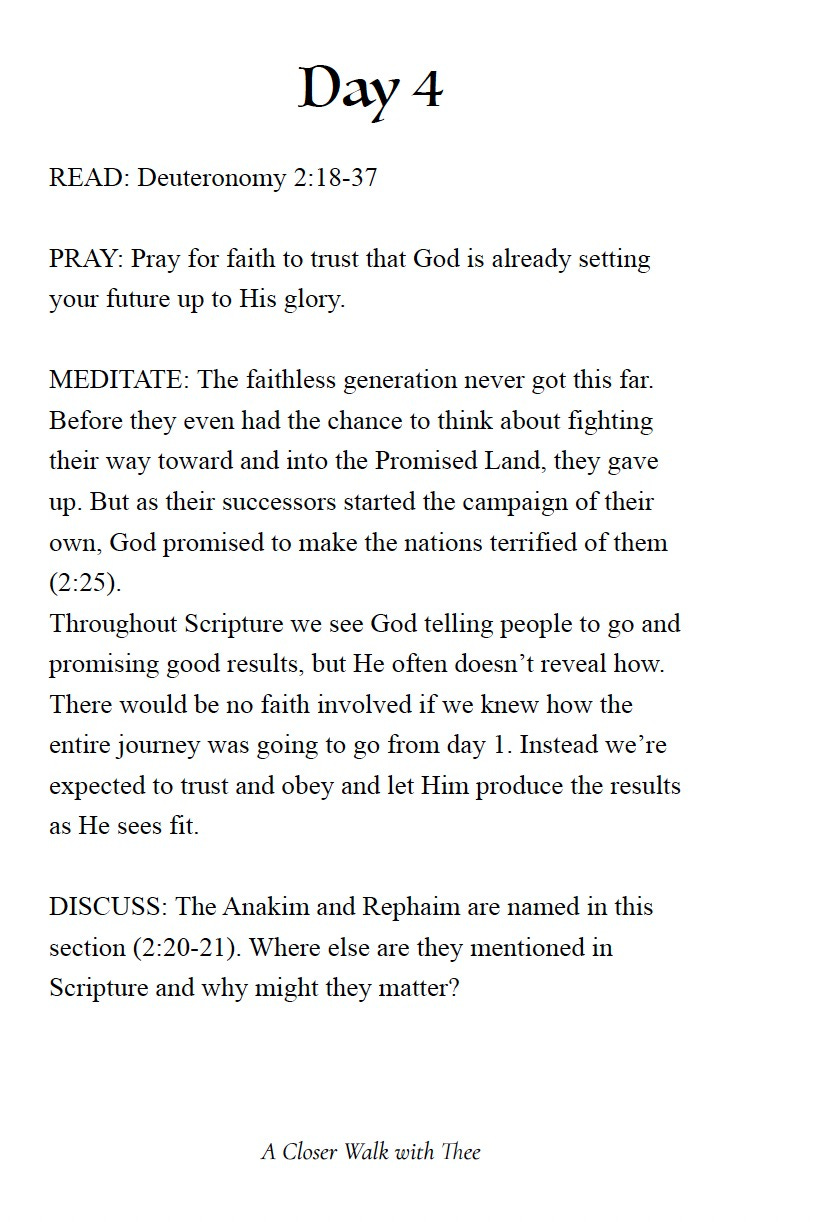
It’s not too late to get started on our A Closer Walk with Thee devos for your year! Each 90 day volume works through the text from Genesis 1, all the way up to 2 Samuel 12 at the end of the recently released Vol. 4. Each day has a brief reading, a prayer, a meditation, and a discussion question.
Or, get a digital copy of all 4 volumes as one of the premium subscriber perks! Premium subscribers now get access to 9 eBooks!
Herman Melville, Moby Dick, Project Gutenberg eBook, https://www.gutenberg.org/cache/epub/2701/pg2701.txt. Accessed December 18, 2025.
Excellent. Sadly, this is a path too many are walking too often.
Brilliant. Thank you for such an insightful piece, Jack. Something we can really use in our everyday lives, and a good reminder to strive to walk with God and closely follow His word.