


There’s a mindset I keep running into among Christians that I find completely baffling. It’s one of those underlying assumptions that nobody really teaches directly, but it’s there in the background, and it colors one’s approach to all kinds of issues.
Many Christians seem to deny the concept of cause and effect when it comes to our ability to impact the world.
They seem to think that the events of this world just happen, and we are all bystanders as they do. When I posted about Islam’s growth in the West the other day, I was told that Christians don’t need to think about such things, as God will handle that and we should just focus on the kingdom.
How can you read the Bible and think a pagan religion’s growth in a nation, in the midst of Christianity’s decline, has nothing to do with us?
Our combination of individualism and pietism has led us to believe that we can control our own lives and what we do, but outside of that, the world just marches on irrespective of us.
This lie is crippling us. We will not even be able to begin to address the numerous challenges facing us until we realize that we have many of those challenges because of our actions.
On the bright side, this also means our actions can overcome those challenges. We can do something about it.
A few examples of where this mindset shows itself:
The state of the culture
Just about everybody is in agreement that our culture is in disarray, and that things used to be better in many ways. However, many insist that this is just something that happens. “Empires rise and fall, but God’s church keeps marching on,” they’ll say.
Ok, but why do empires rise and fall? Is it not because of their standing before God? This is especially true under the reign of Christ, but it still applied in the Old Testament. Nineveh faced judgment, repented, and thrived… until they became wicked again.
We inherited a Christianized West. It got that way because of Christians taking agency. Now, we have seen it gutted out in the name of pluralism and “tolerance,” and is now being infiltrated by Islam, Judaism, and Hinduism. That’s really bad. And it got that way because Christians stopped taking agency.
Still, many insist that this is the natural rise and fall of the world, and we should stand back and let it happen. No, it is happening because of us, and it’s up to us to stop it.
This requires strategic, long-term thinking. We have to organize our lives around helping the Gospel re-leaven the culture by the way we preach, the way we vote, the way we raise our families, and more.
The church
Occasionally I’ll hear someone explain declining church attendance as something that happens because “People just don’t want the truth anymore.” In a sense, that can be true. We can’t force people to convert, and many aren’t interested.
But in another sense, people haven’t fundamentally changed. People move in herds. Back then, going to church was just what you did. Now, it’s not.
We as the church have to move the ball back in that direction, and that comes from being a healthier church that impacts the world outside its doors.
For too long we have been lax about sin in the pews, and it shows. The world impacts us way more than we impact it. We shouldn’t need God to send persecution to do the job we should already be doing.
Our own children
The youth dropout rate is inarguably the biggest problem facing the church, but any time the subject comes up, someone is quick to correct me that nobody can make their kids be faithful.
While that’s true, it’s ridiculous to think that parents’ actions don’t impact their kids’ faithfulness. They essentially characterize it as a coin toss, telling parents who raised all faithful children they “got lucky.”
But we all know that’s nonsense. Everybody agrees that the family who brings their kids to church regularly has a better chance of those kids becoming Christians than the family who comes once every three months.
How much more so for the family who does daily worship in the home, and who teaches their kids to memorize the Word, where the world’s influence from the tv, the phone, and the school are regulated, and where dad, mom, and everybody are committed to living consistently with their professed beliefs?
There’s a reason why having believing children is an elder qualification. There is such a thing as good parenting and bad parenting. Acting as though nobody can analyze why kids fall away because the parents can’t be held responsible is insanity, and it’s hurting us.
Here’s my theory for why we deny ourselves agency in these matters:
If we agree that the challenges facing us are due to our actions, then we have some confessing to do. And if we agree that we have the ability to change things, then we admit that we have a responsibility to change them. And that requires rolling up our sleeves and getting our hands dirty.
It’s just way more comforting to tell ourselves there’s nothing anybody could have done to prevent things from going bad, and therefore nothing we can do to make it better.
That’s not good enough, though.
Just think about the downstream effects of generations of Christians telling themselves that their choices today bear little to no impact on the broader world around them. We cannot afford to live like our choices don’t matter beyond our own personal eternal destination.
No, you can’t fix it all right now. But what you’re doing today can help build momentum for those who come after us. If the loaf hasn’t been leavened, it’s not because that’s just what happens to bread sometimes. Either the leaven is dead, or it isn’t in the bowl. It’s time for us to act like leaven (Matthew 13:33).
You, the person reading this, have more power to affect things than you think, and you need to use it. He who entrusted you with these talents will come calling someday, and you will not want to tell Him you sat on the abilities He gave you because you didn’t think you could make a difference anyway.
Subscribing is free—but if you’d like to support my work, you can become a premium subscriber and get an e-copy of my latest book!
Notes
As always, you can listen to these articles on the go via the Church Reset podcast (Apple, Spotify, or your favorite podcast app).
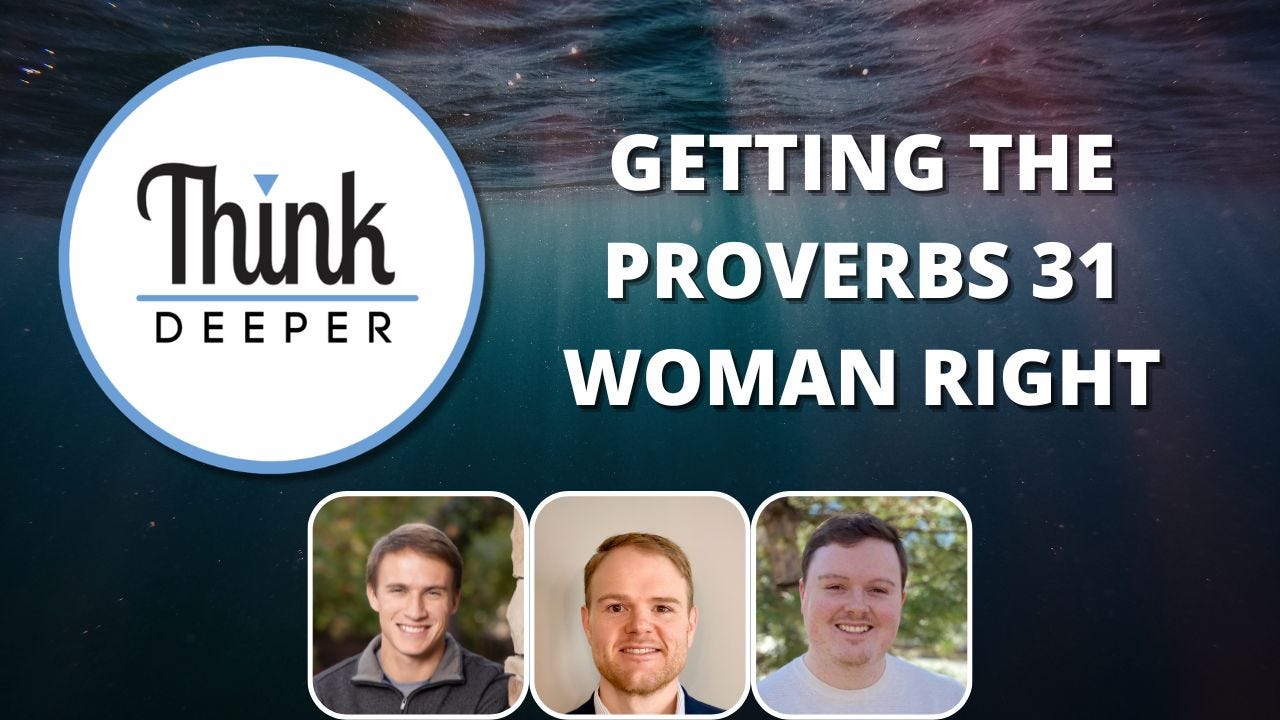
In other podcast news, this week’s Think Deeper Podcast examines the Proverbs 31 woman. Subscribe to Think Deeper on your podcast app to get it when it’s out!
I wanted to let you know I included your post here in my weekly roundup! I hope it is a blessing to you even as your post was a blessing to me. If you’d like to check it out, here is the link: https://fiztrainer.substack.com/p/what-stayed-with-me-week-of-july-4af.
We are not getting the whole gospel or we don't see ourselves being judged for who we live before the world.