
Modesty Isn't Situational
Why treat it like it is?

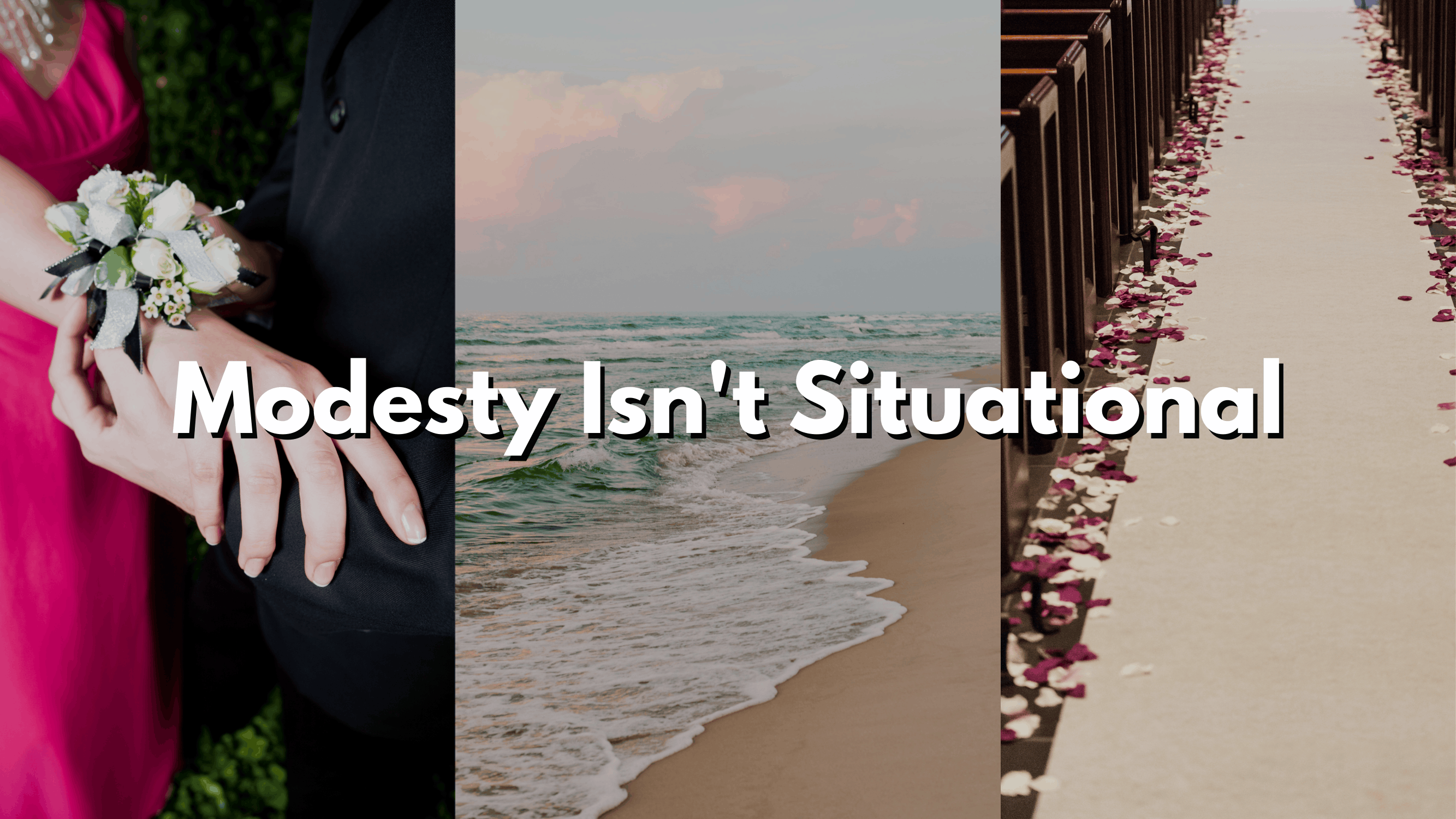
As summer begins, modesty becomes a topic worthy of addressing yet again. It remains one of the most controversial, and therefore most avoided, topics of modern Christian life.
(Let’s get this out of our system early: “Well men need to control their eyes!” Yeah, yeah, we all know. Everybody agrees on that one, so let’s put CS Lewis’ fire extinguisher back on the shelf and stay on topic.)

Of course, we can point to 1 Timothy 2:9-10, where women are told not to dress themselves up fancily but to be clothed properly, “modestly and discreetly,” and “as is proper for women making a claim to godliness” (NASB95).
Some will claim that the passage is solely focused on drawing attention to oneself by lavish dress. That certainly is in mind, but I can tell you something that draws attention way more quickly than a fancy necklace. That’s not being crude, that’s being realistic.
The BDAG definition of modesty includes, “a respect for convention.”1 The question then is, whose convention? A godless, hypersexualized society’s convention? Not hardly. Our standard must be higher.
But beyond the typical appeal to 1 Timothy 2:9-10, I find the word translated “licentiousness” in Jude 4 to be compelling in this discussion, too. Elsewhere it is translated as sensuality, lewdness, or filthy conduct. It can partially be understood as a lack of self-control.
Every time someone rolls their eyes at the modesty discussion, they appeal to licentiousness: “I can do what I want.” No, you can’t. We were explicitly told not to turn God’s grace into license to do whatever we want.
But as much protestation as there is about modesty, it’s really a made-up debate.
Everybody agrees that modesty is important. They just disagree about where the line is.
I mean, does anybody really want to argue that people should be free to walk naked through the grocery store? No, of course not. Should people be allowed to show up to the park in their underwear with kids around? I really, really hope that would be an obvious no for everybody.
So, assuming we’re on the same page there, we’ve established that everybody believes modesty is necessary. After that, it’s just a matter of haggling on the details. That’s where the discussion takes a weird turn.
For some reason, modesty may be the only virtue that is given situational exceptions.
Those exceptions are: formal dress situations (weddings, high school dances, etc.), the gym, and swimming areas. Lest any white knights come riding to the defense of immodest women, the latter two situations apply almost just as much to men.
Inexplicably, things that people wouldn’t be caught dead in elsewhere suddenly become acceptable in those specific instances. Shorts that are too short for walking around Walmart are considered just fine as swimwear. A top that almost completely exposes cleavage is rarely seen in a church building… unless it’s part of a white dress that’s being worn down the aisle. Why?
Imagine if we made these kinds of exceptions for lust. “Ok guys, it’s important that you don’t lust. Unless you’re at a wedding, a formal dance, the gym, or a swimming area. Then, the principle goes out the window. Have at it.”
I’m sorry, what? That’s insanity. If the principle is to have a sufficiently covered body, why should there be a pass on prom night?
Why is it okay to wear less material than underwear in public, around children?
Do the presence of sand and the ocean suddenly make that normal?
What is it about weight training equipment that makes shirtlessness necessary for men, or skin tight, midriff-baring attire necessary for women?
Isn’t the point to not draw attention to oneself and to be sufficiently covered as is becoming a Christian? Why would there be times when that is not necessary?
It’s an absurd framing that has just been commonly accepted, largely without thinking. But our standards should be higher. And, they should be consistent.
As we enter peak immodesty months, don’t lose sight of the kind of light you want to reflect to the world.
Subscribing is free—but if you’d like to support my work, you can become a premium subscriber and get an e-copy of my latest book!
Arndt, W., Danker, F. W., Bauer, W., & Gingrich, F. W. (2000). In A Greek-English lexicon of the New Testament and other early Christian literature (3rd ed.). University of Chicago Press.
Jack, sadly once again, another of your "good vs. better" argument has been torpedoed by the "what abouts" and their handy list of exceptions. This is why we can't have genuine humble and helpful debate anymore. Just a bunch of petulant children dead set on having their way and stiff-arming any attempt at healthy rebuke. Don't bother to stop for a second and maybe consider you could possibly have some room to do better. Just congratulate yourself on finding the loopholes that allow you to keep doing what you want anyway. Oh, and men: you're terrible, it's 100% your problem, and women have no obligation whatsoever to help you in your faith. Nice.
totally agree!!!!
As a woman, I didn't always dress modestly in the past, but it's very important to me now, honoring God with my body.
The tradition of "wearing a dress to church assembly" (tradition, not Scriptural command) has a loophole, because honestly I have worn immodest dresses and justified it because it's "a dress", and I think other women do too, same with wedding dresses and formal dresses, as you point out.